
The Bog
Meeting an Ancient Creature
Series: Field Notes
So there I was, swatting mosquitoes on Victoria Island in the Canadian Arctic. I didn’t come to this relatively remote island because I wanted to engage in that vigorous activity, however. Rather, I came because I wanted to escape what writer Norman Douglas referred to as “the perambulating lunatic asylum of civilization.”
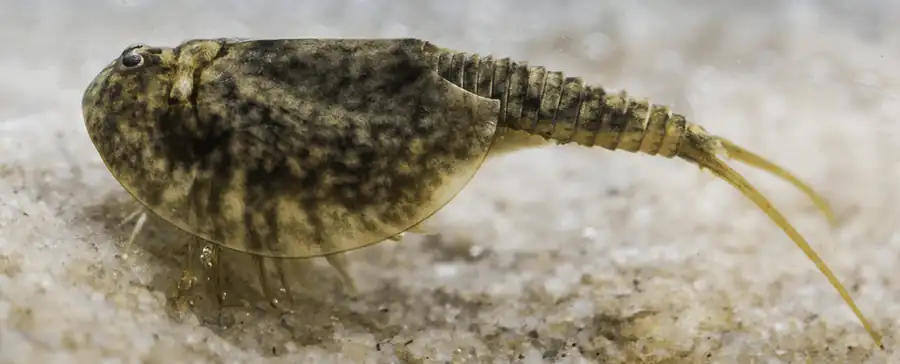
photo by Per Harald Olsen licensed under the Creative Commons Attribution-Share Alike 3.0 Unported via https://commons.wikimedia.org/wiki/File:Skjoldkreps_(Lepidurus_arcticus).jpg

But I also came became I wanted to find an Arctic tadpole shrimp (Lepidurus arcticus), a species that’s neither a tadpole or a shrimp but it’s own particular breed. A scientist friend alerted me to the presence of this not particularly common crustacean on Victoria Island.
Here I should mention that L. articus is the northern cousin of Triops, a species that’s best known as an inhabitant of desert water holes in the American Southwest. The main difference is that Triops species have three eyes (“Triops” means “three eyes”), while L. articus have two. Another difference is that Triops are relatively common not only in the Southwest, but on the internet — you can purchase a larger number of their eggs on Amazon and watch them hatch in a terrarium. Not so L. atticus, which can be found only in the wild.
Between swats, I peered into a shallow moraine pond with the hope of finding the object of my scrutiny. I peered, and then peered some more, but all I saw was a reflection of my own face in the water. Oh yes: I also saw quite a few mosquito larvae swimming around at the bottom of the pond.
I wandered over to another moraine pond, gazed into it, and all of a sudden I saw a horseshoe crab, albeit a miniature one —its humped carapace was probably no more than an inch and a half long. The critter was a L. articus!
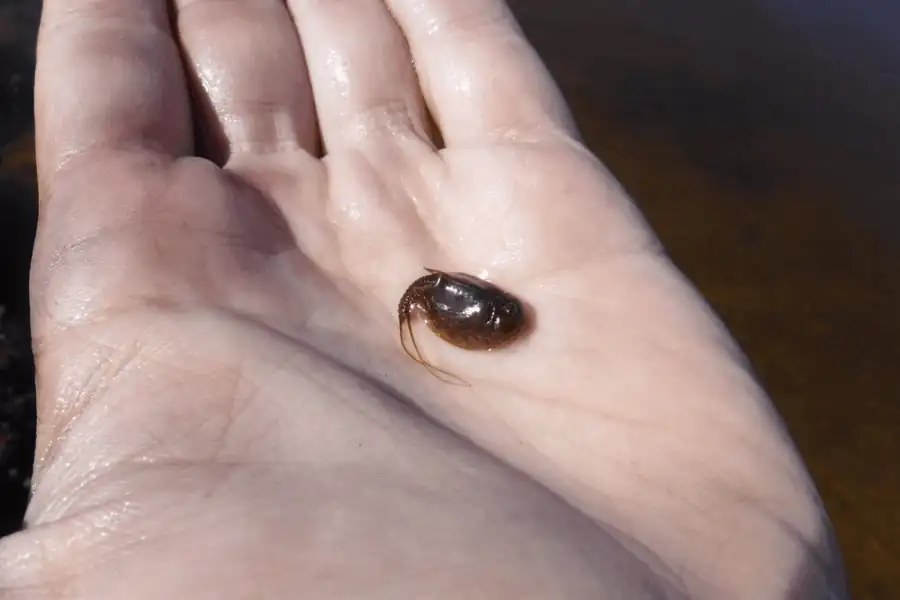
photo by Matthew Zappa licenced under the Creative Commons Attribution 4.0 International license.via /images/bog/lepidurus-arcticus.webp
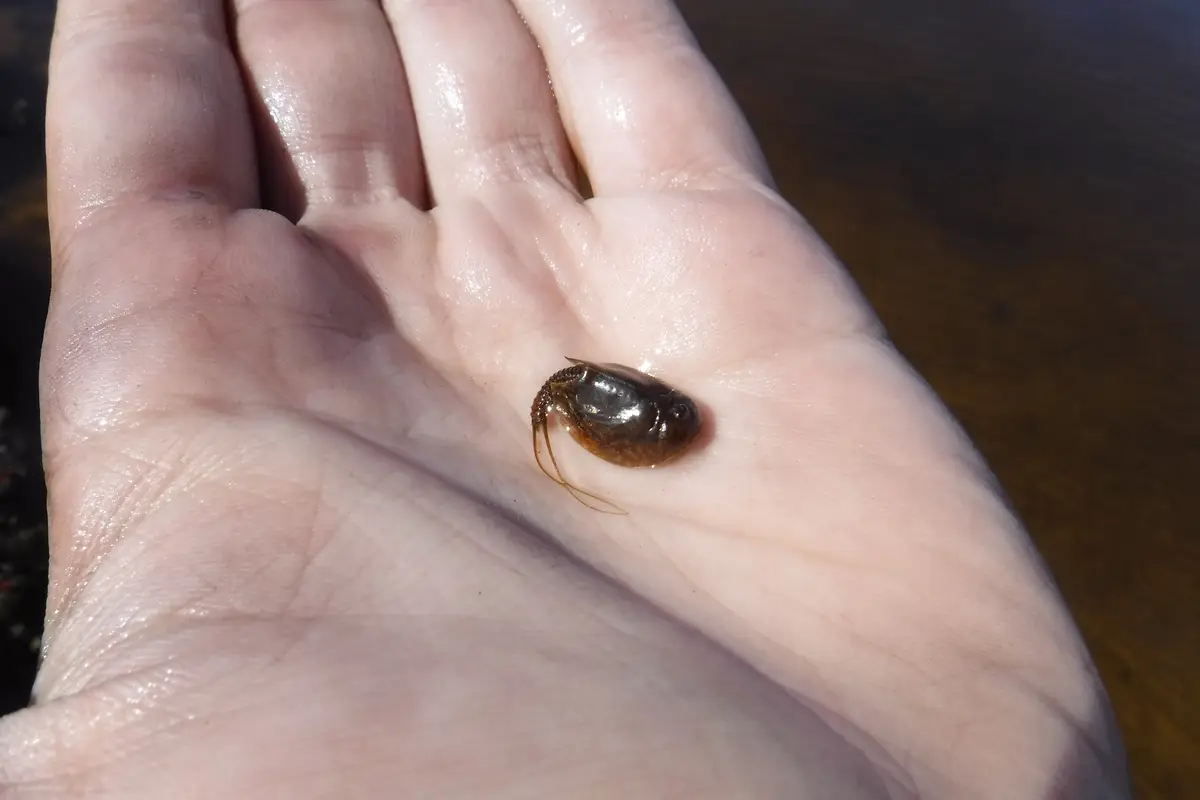
I was far more pleased by the sight of this relatively small arthropod than I would have been if I had found a bag of gold!
I reached down and gently picked up the L. articus and ended up holding in my hand a creature which happened to be one of the planet’s oldest living species. Dare I say that this gave me a sense of primordial delight? The creature in question did not seem to feel delight, though. Its twin poppyseed eyes stared at me with what seemed like obvious displeasure. Clearly, this living fossil did not like being held by a latter-day species, for it tried to spike my hand with its telson, a pointed tail-like appendage on its abdomen.
I knew L. articis liked to eat mosquito larvae, so I tried to capture a few from the bottom of the pond, but they kept swimming away. Then I wondered if it might like to eat adult mosquitoes as well, so when one of these blood suckers landed on my arm, I swatted it, and then put carcass the next to the L. articus in my hand. Ah, success, I thought, when the L. articus began to wiggle toward the mosquito…
…but then it continued wiggling until it escaped my grasp and splashed into the pond, a much healthier habitat than the palm of my hand. Oh well, I thought, at least I’ve had the pleasure of getting up close and person with an early Jurassic survivor…
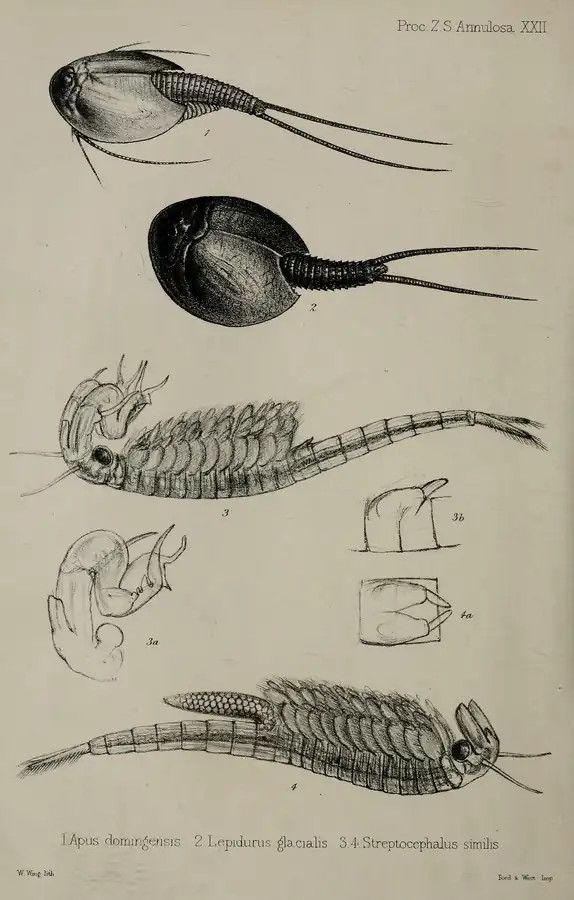
picture by W.Wing, 1 American Tadpole Shrimp, adult 2 Arctic Tadpole Shrimp, adult 3 Caribbean Fairy Shrimp, adult male (3a: second antenna from lateral, 3b: gonopod from lateral) 4 Caribbean Fairy Shrimp, adult female (4a: gonopods from ventral) in the public domain in its country of origin and other countries and areas where the copyright term is the author’s life plus 70 years or fewer. via https://commons.wikimedia.org/wiki/File:PZSL1852PlateAnnulosa22.png

First Posted on December 6, 2025 by Lawrence Millman
More from the Bog
- Among the Stricken October 30, 2026
- A Most Valuable Utensil October 19, 2026
- Kuujjuaq Project Report October 12, 2026