
The Bog
Among Headhunters
Being a backward sort of guy, I’ve always liked to hang out with similarly backward people. An example: the Iban of Borneo. That they were head-hunters, or former headhunters, didn’t bother me. At least they weren’t addicted to technology like so many other human beings I’d encountered.
Some years ago I was sitting in an Iban longhouse in the Nanga Ghokar region of Sarawak. Seated next to me was the chief, a middle-aged man whose circuitry of tatoos made him look like a work of abstract art. Seated on the other side of me was my translator, a part-Malaysian, part Iban man named Bakhri.
Do the local Iban still take heads? I wondered. The chief shook his own head. The last heads they took belonged to members of the Japanese Imperial Army during World War II. This deed was inspired by the so-called Ten Bob A Nob program, a government act through which an Iban would get ten shillings for each Japanese soldier’s “nob” (i.e., head) he took.
“So you don’t even take heads to stay in practice?” I asked.
The chief shook his head again. In the old days, a man couldn’t get a wife unless he took an enemy’s head as a trophy. The most popular guy with the girls was the one who took the most heads. Nowadays the girls preferred getting a different trophy such as, for example, a sewing machine. A nearby woman with generously distended earlobes smiled in agreement.
“From where do you get your sewing machines?” I said.
“From traders in Brunei,” the chief replied.
The chief noticed my disappointment and told me the next longhouse over might have some bags of human heads. Would I like him to call them and find out?
“How would you be able to call them?”
“He’ll use something called a telephone,” Bakhri interceded.
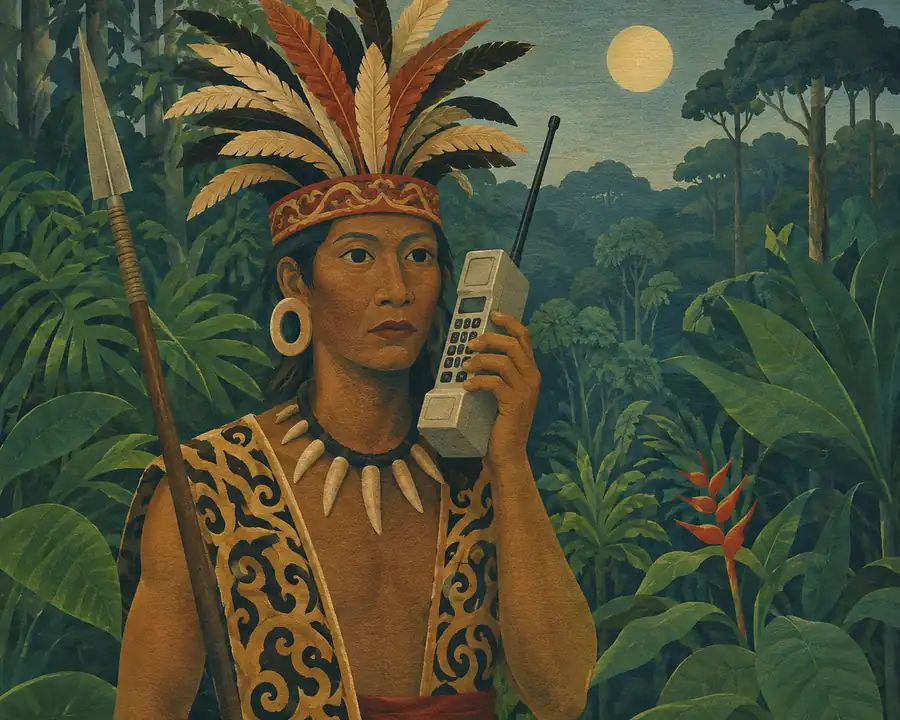
In fact, the chief brought out a handheld mobile phone. It was among the first items of that sort that I’d ever seen. That’s because my visit occurred a bit before such items had become popular, but also because I tend to cast my eyes in the opposite direction from devices such as mobile phones.
Seeing my bafflement, the chief looked at me as if I might be something akin to a latter-day Neanderthal.
“From where did you get your phone?” I asked
“It also came from traders in Brunei,” the chief said. Then he phoned the longhouse in question and learned that they did indeed have several rattan bags of human skulls. He also learned that such skulls were popular with tourists, who invariably hauled out their cameras and took pictures of them.
By the way, did I know what a camera is? the chief asked. In response, I took out the camera from my backpack and displayed it for him.
The reader may wonder if I did in fact visit the next longhouse over. No, I didn’t, for I had no desire to find myself in a crowd of camera-wielding tourists. Instead, I decided to spend a few more days at the present longhouse and learn more about its folklore. An example of its folklore: a plant called tongkat ali was used as the local equivalent of viagra.
A day or so later, Bakhri told me he’d heard a conversation between the chief and some of his higher-ups that in fact pertained to me. Here is a summary of that conversation:
Being an American, I must have considerable wealth. Thus I would make a good mate for one of the unwed local girls and, in the process, be an ongoing source of income for the longhouse. But then there was my ignorance. Who knows what other objects besides mobile phones I might be unfamiliar with?
Maybe I didn’t even know what an outboard motor was! In all probability, no girl would be interested in marrying me.
Let me confess that I was delighted to hear Bakhri’s story. For it confirmed that I was a truly backward sort of guy.
More from the Bog
- Among the Stricken October 30, 2026
- A Most Valuable Utensil October 19, 2026
- Kuujjuaq Project Report October 12, 2026