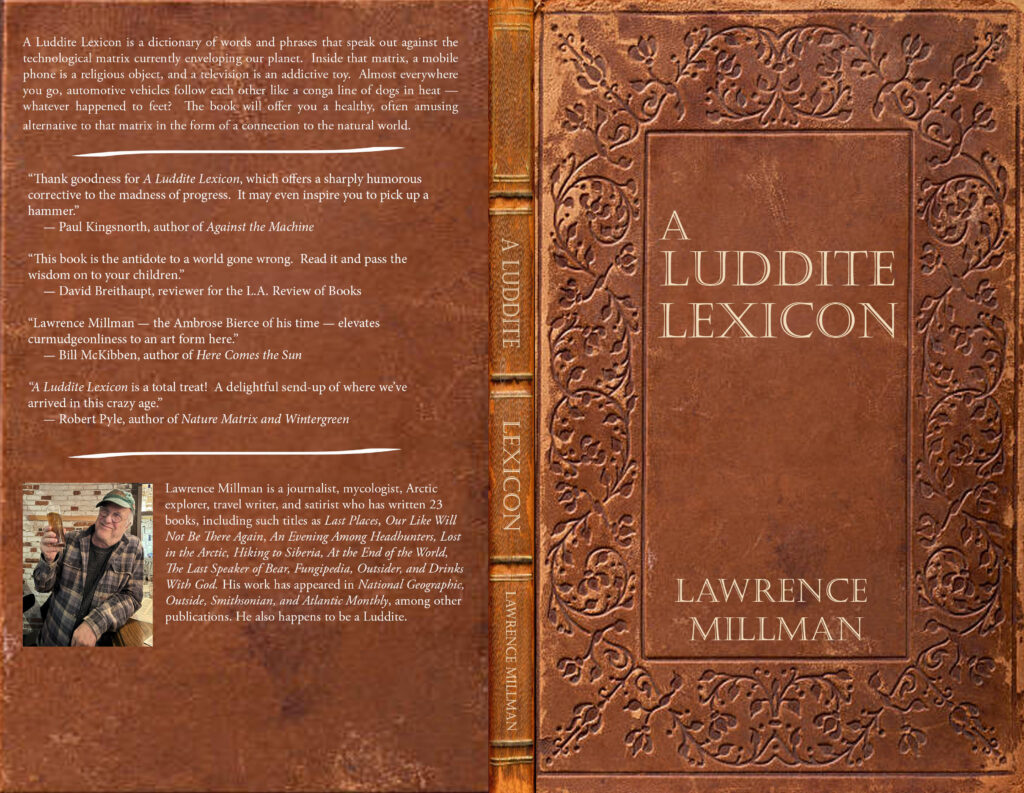
A Luddite Lexicon is a dictionary of words and phrases that speak out against the technological matrix currently enveloping our planet. Inside that matrix, a mobile phone is a religious object, and a television is an addictive toy. Almost everywhere you go, automotive vehicles follow each other like a conga line of dogs in heat – whatever happened to feet? The book will offer you a healthy, often amusing alternative to that matrix in the form of a connection to the natural world.
“Thank goodness for A Luddite Lexicon, which offers a sharply humorous corrective to the madness of progress. It may even inspire you to pick up a hammer.” – Paul Kingsnorth, author of Against the Machine
“This book is the antidote to a world gone wrong. Read it and pass the wisdom on to your children.” – David Breithaupt, reviewer for the L.A. Review of Books
“Lawrence Millman – the Ambrose Bierce of his time – elevates curmudgeonliness to an art form here.” – Bill McKibben, author of Here Comes the Sun
“A Luddite Lexicon is a total treat! A delightful send-up of where we’ve arrived in this crazy age.” – Robert Pyle, author of Nature Matrix and Wintergreen
So there I was, swatting mosquitoes on Victoria Island in the Canadian Arctic. I didn’t come to this relatively remote island because I wanted to engage in that vigorous activity, however. Rather, I came because I wanted to escape what writer Norman Douglas referred to as “the perambulating lunatic asylum of civilization.”
But I also came became I wanted to find an Arctic tadpole shrimp (Lepidurus arcticus), a species that’s neither a tadpole or a shrimp but it’s own particular breed. A scientist friend alerted me to the presence of this not particularly common crustacean on Victoria Island.
Here I should mention that L. articus is the northern cousin of Triops, a species that’s best known as an inhabitant of desert water holes in the American Southwest. The main difference is that Triops species have three eyes (“Triops” means “three eyes”), while L. articus have two. Another difference is that Triops are relatively common not only in the Southwest, but on the internet — you can purchase a larger number of their eggs on Amazon and watch them hatch in a terrarium. Not so L. atticus, which can be found only in the wild.
Between swats, I peered into a shallow moraine pond with the hope of finding the object of my scrutiny. I peered, and then peered some more, but all I saw was a reflection of my own face in the water. Oh yes: I also saw quite a few mosquito larvae swimming around at the bottom of the pond.
I wandered over to another moraine pond, gazed into it, and all of a sudden I saw a horseshoe crab, albeit a miniature one —its humped carapace was probably no more than an inch and a half long. The critter was a L. articus!
I was far more pleased by the sight of this relatively small arthropod than I would have been if I had found a bag of gold!
I reached down and gently picked up the L. articus and ended up holding in my hand a creature which happened to be one of the planet’s oldest living species. Dare I say that this gave me a sense of primordial delight? The creature in question did not seem to feel delight, though. Its twin poppyseed eyes stared at me with what seemed like obvious displeasure. Clearly, this living fossil did not like being held by a latter-day species, for it tried to spike my hand with its telson, a pointed tail-like appendage on its abdomen.
I knew L. articis liked to eat mosquito larvae, so I tried to capture a few from the bottom of the pond, but they kept swimming away. Then I wondered if it might like to eat adult mosquitoes as well, so when one of these blood suckers landed on my arm, I swatted it, and then put carcass the next to the L. articus in my hand. Ah, success, I thought, when the L. articus began to wiggle toward the mosquito…
…but then it continued wiggling until it escaped my grasp and splashed into the pond, a much healthier habitat than the palm of my hand. Oh well, I thought, at least I’ve had the pleasure of getting up close and person with an early Jurassic survivor…
picture by W.Wing, 1 American Tadpole Shrimp, adult 2 Arctic Tadpole Shrimp, adult 3 Caribbean Fairy Shrimp, adult male (3a: second antenna from lateral, 3b: gonopod from lateral) 4 Caribbean Fairy Shrimp, adult female (4a: gonopods from ventral) in the public domain in its country of origin and other countries and areas where the copyright term is the author’s life plus 70 years or fewer. via https://commons.wikimedia.org/wiki/File:PZSL1852PlateAnnulosa22.png
Hardly anything, not even an infant asleep in a stroller, raises the oxytocin of certain people to such Everest-like heights as the sight of a wide-eyed, round-headed Canis familiaris, otherwise known as a dog. Words like lovable, adorable, and cute emerge immediately from the viewer’s mouth. But the animal in question does not have a lovable relationship with the environment. Quite the contrary. I don’t simply mean the fact that it barks at or runs after birds, especially breeding ones, thus causing a dramatic reduction in their population. I mean something far less obvious — the answering of nature’s call, an act that can transform nature itself into a veritable minefield.
Chacun_son_tour Charles J Sharp, Public domain, via Wikimedia Commons
In the U.S., domesticated dogs deposit approximately ten million tons of fecal matter a year in yards, urban green spaces, and forested areas. Here I should say they once deposited that amount. For dog ownership has risen dramatically during the current pandemic, and the volume of dog poop has risen dramatically as well. What becomes of that poop? Some people might think they’re being eco-minded by putting it into an aquamarine plastic bag, then tossing that bag in the trash, but they don’t seem to realize that they’re contributing to the plasticization of the planet (a plastic bag in a landfill can take upwards of 500 years to decompose). Quite a few others leave a poop-filled plastic bag on the ground or simply fling it away — are they expecting the poop fairy to remove it?
Good boy or good girl, a cute little dog’s owner might say after their canine companion has pooped. But since that typically brown, squishy poop itself isn’t cute, many owners will leave it exactly where it’s been deposited rather than put it in a plastic bag. There it will remain, slowly but surely biodegrading, and (as you’ll soon find out) wreaking havoc on its habitat as it does so. By contrast, the poop of wild mammalians breaks down quickly, and the soil benefits from their poop’s nutrients, which includes all sorts of organic matter.
Since one’s canine companion has dined primarily on processed foods, its poop contains nitrate compounds that tend to reduce the oxygen level in the soil. The change in soil chemistry can be quite harmful to plants…or I should say native plants. This change can either kill them, cause their leaves to drop prematurely, or prevent them from producing any flowers. But invasive plants have a literal field day in what might be called the immuno-compromised soil. For example, garlic mustard is far more common in areas where dogs have been walked than in other areas. Not surprisingly, those other areas are more biodiverse than the areas with dogs.
Garlic Mustard blooming at the edge of a city yard in Pittsburgh shared by Cbaile19 under a Public Domain License via Wikimedia.com
According to the FDA, one gram of a dog’s poop boasts roughly 25 million fecal bacteria, including salmonella, giardia, Staphylococcus, and E. coli. These bacteria get transported through the soil and often contaminate local groundwater, rivers, and waterways. Thus you should be very careful about your drinking water, unless you’d like to get a serious bacterial infection. And be careful what you touch, too. For in your dog’s poop reside roundworms that can cause recurrent diarrhea as well as eye and lung infections.
If you think your dog’s pee is less pernicious than its poop, you’ve got another think coming. For this pee is extremely rich in urea, an acidic compound that contains 48% nitrogen. A little nitrogen is not a bad thing, but too much nitrogen, well, consider a study done in England a while back that documented dogs peeing on lamp-posts. Constant peeing caused the bases of those lamp-posts to crumble. In 2015, a lamp-post fell onto a car in San Diego, narrowly missing the driver. In all probability, dog pee was the cause of its fall.
It’s an easy segue from lamp-posts to trees. In order to mark or counter-mark what they consider their territory, male dogs look around for something vertical, and voila! there happens to be a tree. Up goes a leg, and out shoots a flow of urea that goes down the tree’s trunk and into its roots. If enough dogs pee on a tree, it’s probably goodbye to the tree. A fungus killed that tree, a lot of people will think, not realizing that man’s (and woman’s) best friend caused the tree’s demise. It shouldn’t be a surprise that trees along forested paths have suffered more from the flow of canine urea than trees off those paths.
So what’s the best way to solve the problem I’ve just described? Perhaps exchange your dog for a more eco-friendly pet such as a goldfish or a canary? This wouldn’t work, since neither of these critters will raise your oxytocin very much. How about giving up your best friend for adoption? That won’t work, either. For you’d be simply bequeathing the dog to a different owner, who would also take it on several lavatorial walks a day.
Personally, I think the best solution is what I’ve tried to do in this essay — inform folks about the negative effect their pet dogs can have on the natural world. Otherwise, there will be more and more incidents like the one I experienced a few years ago, when I was walking through a wooded area (walking myself, not a dog) in Cape Cod. I happened to see a Labrador retriever squatting and pooping in a hemlock grove. The dog’s owner was gazing at her cellphone, oblivious to this act. Will you please clean up after your dog?, I asked her. If you don’t like dogs, you shouldn’t be in the woods, she told me. Here’s my translation of this rather abstruse statement: the environment plays second or even third fiddle to my darling doggy.
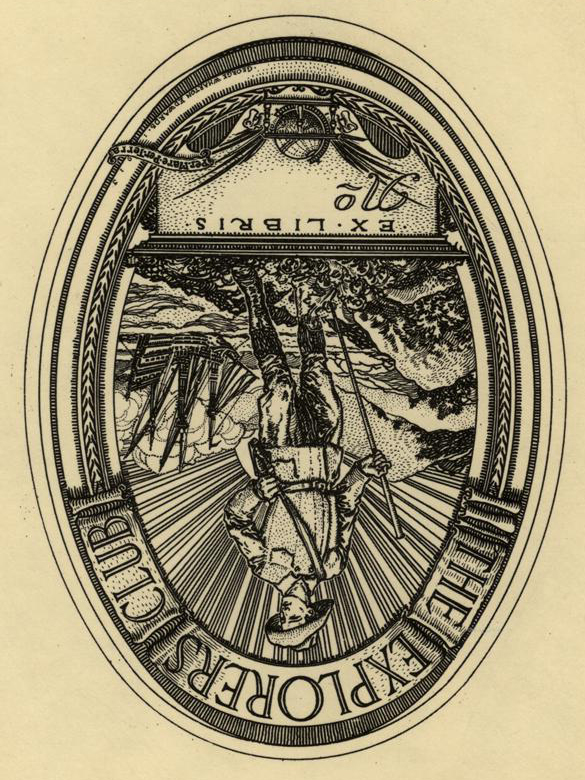
Once upon a time the Explorers Club was one of the most prestigious organizations on the planet. Its past members included such eminences as Richard Peary, Thor Heyerdahl, Charles Lindbergh, Peter Freuchen, Tenzing Norgay, and Sir Edmund Hillary. But the Club has recently gone downhill to such a degree that actual exploration is no more a part of its agenda than, for instance, frisbee throwing.
The location of the Club’s headquarters — 46 East 70th Street on New York’s Upper East Side — offers a window on its nosedive. The Upper East Side is an upscale habitat where money is the lingua franca, and its denizens (who include many of the Club’s officers) speak it as their primary language. Certain Club members have been known to suggest that the Explorers Club should be renamed The Upper East Side Club. Attempts to relocate it to somewhere else have come to naught…for the same reason that you can’t relocate Wall Street.
In the last twenty or so years, the Club has revamped itself to attract the corporate sponsors who live around the metaphoric corner. To do this, its officers can’t say, “Hey, we’ve got a guy who’s searching for Thule Period Inuit sites on Jan Mayen Land.” The corporate types would blink their eyes uncomprehendingly. But those officers can say, “Here’s a guy who’s an aerospace biochemical engineer.” In fact, a Lowell Thomas Award was recently given to one such individual.
“Remote sensing” is a phrase that nowadays has considerable appeal to the Club’s technocratically-biased higher ups. As a prank, I sponsored a putative explorer named Albert Yetti, an Abominable Snowman expert who used remotesensing to find his subject so he wouldn’t have to leave his UpperEast Side abode. Albert Yetti would have been admitted to the Club if I hadn’t confessed that I created him.
I’ve been one of many members who hasn’t been eager to dance to the corporate drummer. A Club president — a fellow who put an anaerobic tent in his office and lived in it — did not appreciate our nay-saying and threatened to drag us, he said, “kicking and screaming into the 21st century.” To my mind, this is a lot like Henry Morton Stanley’s (of Stanley & Livingston fame) positive take on slaughtering his way across Africa to rescue Emin Pasha (who did not want to be rescued). “I opened it [Africa] to the civilizing influence of commercial enterprise,” Stanley said.
In 2017, I asked the Club whether I could give a presentation on my exploration of a remote part of Hudson Bay. “But you’re not an explorer,” I was told. This is true, if Elon Musk and Jeff Bezos, both of whom have won major awards from the Club, are regarded as explorers. After all, I’ve made 40+ expeditions to the Arctic and Subarctic, but I’m not a technology entrepreneur. Indeed, I have no association whatsoever with either Tesla Motors or Amazon. I have explored a part of the Amazon, but doesn’t count…nor does the fact that I’ve been a Fellow of the Club since 1990.
“You’re not an explorer” was the proverbial final straw, and I let my membership in the Explorers Club lapse. In doing so, I was in good company, for Conrad Anker, Paul Theroux, etc, have also let their memberships lapse. I’m now planning to join the Whiskey Explorers Club, which I suspect is a much healthier organization.




.jpg)


