Kuujjuaq Project Report
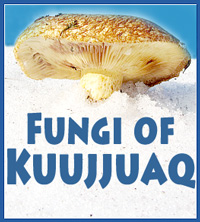
Fungi of the Kuujjuaq region, Nunavik, Quebec, Canada
Collections made 12-18 August 2007 by Lawrence Millman
In 2007, I received a grant from Nunavik’s Makivik Corporation to study the mushrooms in and around Kuujjuaq. This community, the largest in Nunavik, was ideally situated for mycological research, since it was both above and below the tree-line. Here are the results:
See also: Twenty Kuujjuaq Fungi, and the Kuujjuaq Species List.
Kuujjuaq Project Report
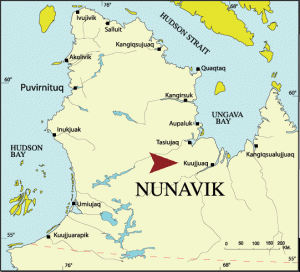
The red arrow points out Kuujjuaq, an Inuit community in northern Quebec, Canada.
In and around Kuujjuaq, I investigated three more or less different habitats: northern boreal forest (southwest of Kuujjuaq), tundra (north and west of town), and the mixed- disturbed area between the airport and the Koksoak River. Most of the fungi I identified in these habitats were host-specific mycorrhizal species. For example, Lactarius rufus (Red Hot Milky) and Leccinum scabrum (Birch Bolete) grew with spruce and dwarf birch, respectively. The habitat with the greatest number of species was the area between the airport and the Koksoak River. For it’s usually the case that the greater the variety of plants and trees, the greater the variety of fungi. On the other hand, the habitat with the largest fungal biomass was — perhaps surprisingly — the tundra. One reason for this is that there isn’t as much competition for space in a tundra as there is in a forest or a mixed habitat. Another reason: the large, anchoring roots of tundra plants and trees seem to inspire fungal mycelia to produce fruiting bodies.
Among local Inuit, there’s almost no tradition for harvesting fungi. Mushrooms are referred to as tunitniqingit, caribou food, and the general sense I got from speaking with elders was that they were fit for caribou, but not human consumption. One elder did mention that the puffball known as a pujuolak was used medicinally when he was growing up. If someone cut himself, he’d place the soft yellow spore mass of a pujuolak on the wound, then tie it there with a string. The puffball would keep the wound from getting infected and also aided in the healing process. Strange as this might seem, it does have a basis in science, since some fungi (pencillin is, after all, made by a fungus) have strong antibiotic properties. However, the medicinal use of pujuolaks seems to have died out in the Kuujjuaq area.
As part of this project, I was asked to identify potentially harvestable mushrooms, and the two species I would most recommend are Leccinum scabrum (Birch Bolete) and Leccinum insigne (Aspen Bolete). The field differences between these two boletes are slight — L. scabrum usually has more pronounced projections on its stalk, and L. insigne typically stains purplish-grey, then black when cut or bruised. As both are good edibles, there’s no need to make a positive ID before collecting them. Also, both fruit in considerable quantities during the mushroom season, August and September. Since they likewise fruit in considerable quantities in other parts of Canada, I would not encourage attempts to market them. Note: Another good edible, Rozites caperata (Gypsy), fruits in the area, but as there’s a slight risk of confusing it with a poisonous Amanita, I would not recommend it to beginners.
As a cautionary measure, I asked Michael Kwan to test tissue samples of several Leccinum specimens for toxic elements. After all, the harvest of edible mushrooms in certain parts of northern Europe has occasionally been curtailed due to pollutants in the air or the ground. The result of these tests was reassuring. There were measurable amounts of cadmium and mercury in the mushrooms’ caps, but the concentrations were not high enough to be a health concern. Lead was hardly detectable, and nickel and arsenic levels were both very low. Thus the two Leccinums are safe to collect (idea: give them an Inuktitut name).
With this project, I hope I have laid a useful foundation for the future study of fungi — whether by me or someone else — in the Kuujjuaq region, indeed in Nunavik itself.
Proceed to Twenty Mushrooms of the Kuujjuaq Area, or the Kuujjuaq Full Species List.