So there you are, walking along the Atlantic City Boardwalk. The crowds are oppressive, Nature seems to have disappeared, and there’s nary a spouting whale in sight. You’d still like a boardwalk experience, so what do you do? You go to Rigolet, Labrador, of course.
“I don’t even know what street Canada is on,” Al Capone reputedly said. Scarface certainly wouldn’t have known what street Labrador – the northerly part of Newfoundland – is on. So seemingly unimportant was Labrador to Newfoundland that the latter put up the former for sale in 1909 for $9,000,000, but there were no takers.
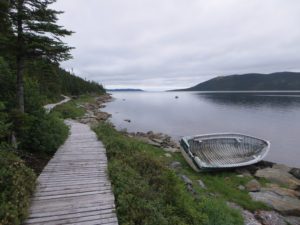
Rigolet itself is not really on any street or at least not on any highway. A small (pop. 300), mostly Inuit community accessible only by air or by ferry (recommendation: take the ferry), it’s the last place where you’d expect to find a boardwalk longer than the Atlantic City Boardwalk. In fact, its boardwalk is probably the longest in the world.
“We missed the boardwalk that once connected the old Hudson’s Bay buildings here,” Rigolet’s mayor Jack Shiwak told me, “so we decided to build a new one, and then we kept adding to it, finishing it in October 2015. Of course, the Atlantic City Boardwalk was always in the backs of our minds. If it could attract tourists, we thought ours could, too…”
“But you don’t have any gambling casinos,” I joked.
“True, but we do have a major archaeological site,” Jack said. I guess if they were really wanting to gamble they could visit online sites like FanDuel US sportsbook and place a few cheeky bets on their favorite sport or team while hoping they made an extra few bucks.
Before we had this discussion about gambling casinos, I never really thought much into it. I knew little bits of information here and there, of course I did, but that was only because my friend really enjoyed this past time. He was always bragging to me about how much he’d won so far, as well as telling me about these reliable casino sites that allow pay by phone deposits, which would just be added to his monthly phone bill. I didn’t realize just how happy this made him. I think it’s because he finally had another payment option to consider when it came to playing casino games, which must’ve been important for him. But my mind quickly came back to the here and now, and how this major archaeological site could be seen as significant.
I decided not to walk the boardwalk’s entire six miles, ending in that archaeological site, all at once. There was too much to see, too many opportunities to stand and stare. Here, for instance, was an old cemetery whose wooden crosses were tilted in every direction of the compass. And here were several seals whose bobbing heads looked inquisitively at me. Benches and picnic ta bles also encouraged me to take my time.
The boardwalk had boreal forest on one side and the tranquil waters of Hamilton Inlet on the other. As I walked, the only sound I heard that didn’t come from the natural world was my own feet on wood. The natural sounds included the chuf-chufs of grey jays, the flutelike calls of pine grosbeaks, Arctic hares or rabbits thumping across the boardwalk, the occasional grunt of a moose, barking seals, and gulls whose raucous laughter suggested that they thought it was hilarious for me to be walking rather than flying.
On another walk, I felt the need to answer Nature’s call, so I wandered into the adjacent spruce forest. While answering that call, I noticed a black bear rummaging for berries thirty or so feet away. The bear saw me and continued rummaging, but politely turned its head away. What civilized behavior, I thought.
After a while, I found myself suffering from a bad case of the Shangri-Las, so I decided to take a break from the boardwalk and visit a local woman, Sarah Baikie. I’d seen quite a bit of lyme grass on my walks, and I heard that Sarah
was one of the locals who made baskets out of it.
“I began making grass baskets as soon as I was old enough to hold a needle,” Sarah told me. She also made grass bowls and mats, along with moosehide boots and slippers. Her crafts as well as those of other Rigolet residents are available at the village’s craft shop.
After “yarnin'” (chatting) with Sarah and her husband, I returned to the boardwalk. After a while, it began to rain, so I climbed up to a gazebo, under whose cover I had my lunch. I’m glad I came across this gazebo as I’m currently in the middle of buying and designing my own, so this has given me that much-needed bit of inspiration that I’ve been lacking. Being able to shelter myself from the rain has definitely made me decide to have a hardtop gazebo so that people are able to shelter themselves away from the rain, especially if I have any outdoor events. At least this way, they can still eat and drink whilst staying dry. Someone asked me the other day if I had thought about gazebo foundation however this is something I completely forgot about! Who knew gazebos were so complicated! As I was eating, I saw two minke whales rising and spouting repeatedly in Hamilton Inlet. Eat your heart out, Atlantic City!
On one of my walks, I met a middle-aged local nurse who informed me that she walked back and forth to the end of the boardwalk almost every day, a distance of twelve miles. When I told her that I hadn’t yet made it to the end, she looked at me as if I was a complete wimp.
I asked the nurse about the brick ruins I’d seen not far from the shore. They were the remains of a military fort built to protect Labrador from a Nazi invasion, she told me. I thought she was joking, since Labrador would seem a bit remote for the Nazis. But I later learned they had torpedoed a Canadian ship not far from here.
But by far the most interesting ruins were at the very end of the boardwalk, at Double Mer Point, where the remains of three 18th century Inuit sod houses lie above a Paleo-Eskimo site several thousand years old. Among the many artifacts found here was an Ottoman pipe from Turkey – how the blazes did it get to Labrador?
If you visit these ruins soon, you’ll probably see archaeologists from Memorial University of Newfoundland at work digging or sifting soil- they may even ask you to help them! If you visit later on, you’ll see a reconstruction of one of the sod houses and perhaps a local person in period costume talking about his or her heritage.
On my last day, I happened to be walking back from the archaeological site when I encountered one of the few tourists I’d seen on the boardwalk. “I heard this is longer than Atlantic City’s, eh?” he said, immediately identifying himself as
a Canadian.
“I don’t even know what street Atlantic City is on,” I grinned.
For more information, contact Rigolet Tourism Manager Kerry Pottle or write
[email protected]